When companies begin exploring warehouse automation, one of the first questions is: which technology is right for my operation? The answer depends on several factors, including the type of goods stored, the available building height, and the required throughput.
Three technologies appear frequently in discussions: ASRS (Automated Storage and Retrieval Systems), pallet shuttles, and 4-way shuttles. Each has distinct characteristics.
ASRS (Automated Storage and Retrieval Systems)
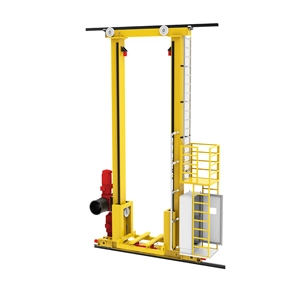
ASRS uses stacker cranes that travel within fixed aisles. These cranes move horizontally along the aisle and vertically up the racking structure to place or retrieve pallets. The racking in an ASRS is typically tall, often exceeding 10 meters and sometimes reaching 40 meters or more.
ASRS is well-suited for warehouses with high ceilings and consistent pallet sizes. It provides high throughput, meaning many pallets can be stored and retrieved per hour. The system operates with minimal human involvement once the pallet is delivered to the crane interface.
Common applications for ASRS in warehouse include manufacturing raw material storage, finished goods buffers, and distribution center reserve storage.
Pallet Shuttle Systems
A pallet shuttle is a motorized cart that runs on rails inside a storage lane. A forklift places a pallet at the lane entrance, and the shuttle carries the pallet to the deepest available position. When retrieval is needed, the shuttle fetches the pallet and brings it back to the lane entrance.
This design allows for very narrow aisles. Traditional forklift operations require wide aisles for turning. With a pallet shuttle, the aisle only needs to be wide enough for the forklift to place a pallet at the entrance. The result is significantly higher storage density.
Pallet shuttles are common in cold storage facilities, where reducing forklift traffic also reduces energy loss from open doors. They are also used in any warehouse where maximizing pallet positions per square meter is the primary goal.
4-Way Shuttle Systems
A 4-way shuttle operates on a grid of rails that run both lengthwise and crosswise at each level of the racking structure. The shuttle can move forward, backward, left, and right. This allows it to change aisles without a separate transfer vehicle and to access any location within the grid.
Four-way shuttles are typically paired with lifts that move shuttles between levels. Multiple shuttles can operate within the same grid simultaneously, with software managing traffic to prevent collisions.
This technology is well-suited for warehouses with many SKUs, high order variability, or e-commerce fulfillment. Four-way shuttles often work with goods-to-person picking stations, where shuttles bring containers to stationary workers.
Comparison Summary
Combining Technologies
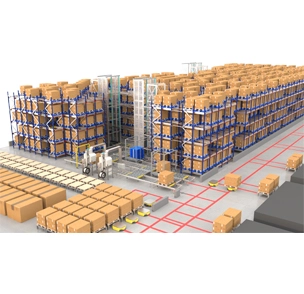
Many warehouses do not choose a single technology. A common hybrid approach uses pallet shuttles for bulk raw material storage, ASRS for finished goods buffering, and 4-way shuttles for order picking. Each system handles the part of the workflow it performs best.
Factors to Consider
When evaluating which technology fits a specific warehouse, several factors should be reviewed:
Building height determines whether ASRS is feasible
Load type (pallet vs. case) narrows the options
SKU count affects the need for flexibility
Throughput requirements influence system scale
Cold storage often favors pallet shuttles due to energy benefits
Conclusion
ASRS, pallet shuttles, and 4-way shuttles each solve different storage and retrieval problems. ASRS maximizes vertical space for high-throughput pallet operations. Pallet shuttles provide the highest density for ground-level or mid-bay pallet storage. Four-way shuttles offer flexibility for warehouses with many SKUs and variable orders.
Understanding these differences helps in selecting the appropriate technology mix for a given operation. A site assessment and data analysis from a qualified provider can provide more specific recommendations.


 English
  Español
  português
  العربية
  tiếng việt
  ไทย
ไทย  Indonesia