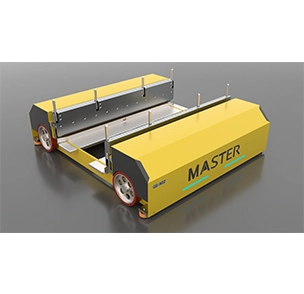
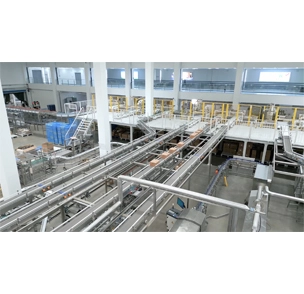
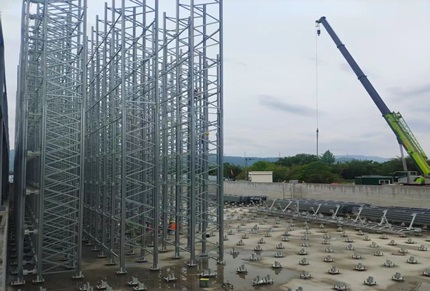
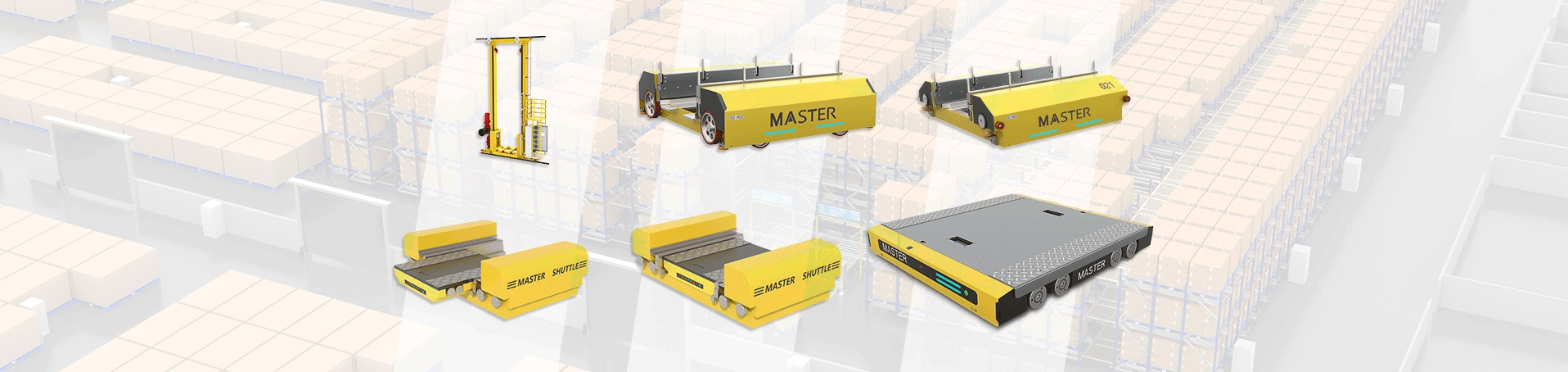
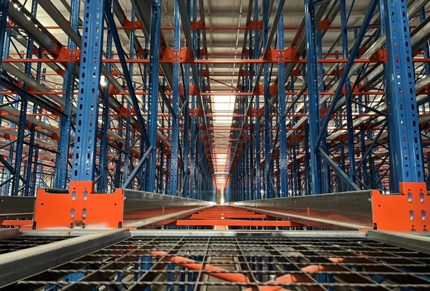
In the field of automated warehousing, the degree of independent control over core technologies often determines a company's product capabilities and market competitiveness. Tianjin Master's technological breakthroughs in four-way shuttle systems are no accident—they are supported by sustained R&D investment and multiple core patents.
This article examines several key patents in Master's four-way shuttle portfolio, revealing the technical logic behind its "height revolution."
Patent 1: Hydraulic Steering and Lifting Mechanism (CN112978181A)
The essential difference between a four-way shuttle and a traditional two-way shuttle lies in its steering capability—the ability to switch from longitudinal to transverse movement within a racking grid. The reliability and smoothness of this steering action directly affect overall system stability.
Master's patented technology (CN112978181A) proposes a four-way shuttle design using hydraulic steering and lifting devices-7. The core innovations of this solution include:
Reduced intermediate transmission links: Traditional steering mechanisms often rely on complex mechanical transmission chains with multiple failure points. Master's solution uses a hydraulic system to directly drive the steering bracket and lifting action, significantly reducing mechanical complexity, resulting in lower failure rates and easier installation and maintenance-7.
Coordinated control of hydraulic lifting and steering: This patent covers not only the steering function but also the design of the lifting hydraulic cylinder—the shuttle lifts or lowers cargo upon reaching its target position through hydraulic action. This design directly affects the precision and reliability of the shuttle's picking and placing operations-7.
Compact structure with low operating noise: By optimizing the hydraulic valve group (including cascaded three-position four-way directional valves and two-position two-way solenoid valves) and control logic, this solution maintains lifting capacity while reducing operating noise-7.
"The four-way shuttle provided by this disclosure is equipped with hydraulic steering and lifting devices, reducing intermediate transmission links, resulting in lower failure rates, easier installation and maintenance, and significantly reducing the operating noise of the four-way shuttle."-7
The application of this patented technology is one of the key foundations enabling Master's four-way shuttles to support high-frequency steering operations and maintain stable operation in high-rise projects.
Patent 2: Digital Twin-Based Logistics Modeling Method (CN118822392A)
If hardware patents determine whether a shuttle can "move steadily," then software patents determine whether the system can "move intelligently."
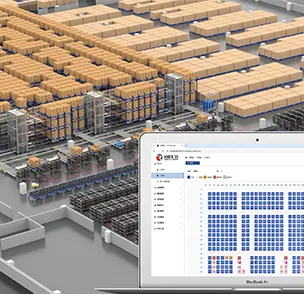
In 2024, Master obtained the patent for "Digital Twin-based 4-Way Shuttle Logistics Modeling Method, System, and Medium" (CN118822392A)-8. This patent addresses the resource waste and inefficiency caused by using complex models in traditional logistics modeling, proposing an optimization solution-8.
Its core approach includes:
Establishing a basic logistics model: First constructing a digital twin framework of the warehouse
Setting checkpoints (JC) mechanism: Setting multiple checkpoints within the model for path screening and optimization
Updating the model based on position data: Refining the basic logistics model into a more accurate "flow logistics model" based on real-time position data from the four-way shuttles-8
"The present invention solves the problem that in existing logistics modeling processes, using complex models causes a significant amount of time to be consumed for path analysis even when calculating a relatively short path... resulting in waste of analytical resources and low overall analytical efficiency."-8
The value of this patented technology lies in multi-shuttle collaborative operations in high-density storage scenarios, where the system frequently needs to calculate optimal paths and avoid congestion. Efficient modeling and optimization of logistics processes through digital twin technology can significantly improve scheduling efficiency, supporting more shuttles operating collaboratively within the same grid—this is the technical guarantee for Master's ability to achieve "multi-shuttle, 24/7 uninterrupted operation" in its projects.
From Patents to Products: Practical Validation of Technological Implementation
The value of patented technology ultimately needs to be validated in real projects.
Master's four-way shuttle products adopt a mechanical cam lifting structural design, with a rated capacity of 1500kg, no-load speed of 1.5-2.0m/s, positioning accuracy of ±2mm, and steering time of approximately 3 seconds-2. The product supports operation in -25°C low-temperature environments and is equipped with energy recovery functionality, saving 30% energy-6. Racking space utilization can reach approximately 90%, 10%-60% higher than traditional storage modes-6.
In the Inner Mongolia Jihong Packaging project, Master deployed 32 intelligent four-way shuttles, achieving multi-vehicle same-level operation (9 shuttles running simultaneously per level) 24/7, with approximately 40% improvement in turnover efficiency, 2-3 times increase in storage space utilization, and over 99% inventory accuracy-3.
Behind these figures lies the equipment reliability enabled by hydraulic steering technology, the scheduling efficiency supported by digital twin technology, and the company's continuous optimization of elevator vertical speed—which Master has increased to more than double the industry average-1.
Breadth and Depth of Technological Accumulation
As of 2025, Master holds over 40 invention and utility model patents, and more than 20 software copyrights-5. These patents cover multiple key technical areas including shuttle body structure, steering mechanisms, elevator design, scheduling algorithms, and digital twin modeling.
Master has been recognized as a "National Specialized and Sophisticated 'Little Giant' Enterprise", and its intelligent equipment management system has been awarded the title of Tianjin "Killer Product". As one of the few companies in the industry with full-chain independent R&D capabilities covering racking systems, various shuttle types, stacker cranes, elevators, conveyor lines, and WMS/WCS software-5, Master's technological breadth in the pallet automated dense storage system field ranks at the forefront of the industry.


 English
  Español
  português
  العربية
  tiếng việt
  ไทย
ไทย  Indonesia