Modern warehouses face a common set of challenges: rising labor costs, limited expansion space, increasing order volumes, and pressure to ship faster. Automation has become a practical response to these pressures. This article provides a basic overview of the main technologies available today.
The Core Technologies
Most automated warehouses rely on a combination of three core technologies. Each serves a different purpose.
1. ASRS (Automated Storage and Retrieval Systems)
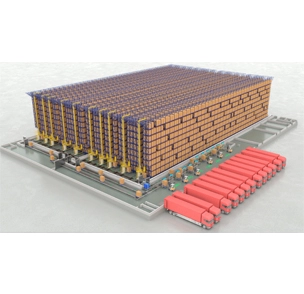
ASRS uses stacker cranes that travel within fixed aisles to place and retrieve pallets from high-bay racking. These systems are well-suited for warehouses with tall ceilings, typically above 10 meters. They prioritize storage density and throughput speed for standardized pallet loads.
An ASRS can operate continuously with minimal human intervention. Inventory is tracked in real time through the warehouse management system, which removes the uncertainty common in manual operations.
2. Pallet Shuttles
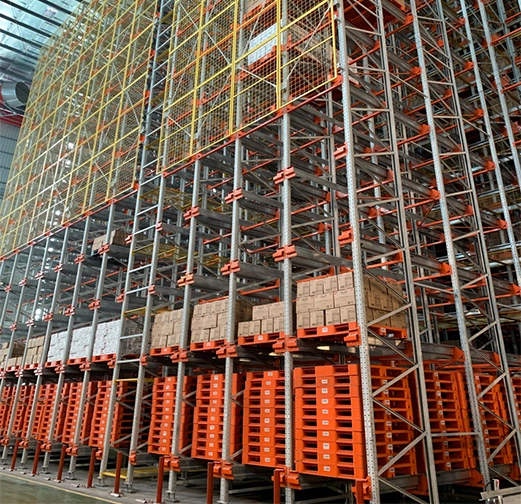
Pallet shuttles are rail-guided carts that move pallets into deep storage lanes. Unlike ASRS, they do not require a crane in every aisle. A forklift places a pallet at the lane entrance, and the shuttle carries it to the designated position inside the lane.
This configuration allows for very narrow aisles, significantly increasing storage density compared to traditional selective racking. Pallet shuttles are common in cold storage facilities, where reducing the number of door openings also lowers energy consumption. They are also used in any application requiring dense, low- to medium-throughput pallet storage.
3. 4-Way Shuttles
A 4-way shuttle operates on a grid of rails. It can move forward, backward, left, and right, which means it can change aisles and levels without external transfer devices. This flexibility makes 4-way shuttles suitable for warehouses with many SKUs, high order variability, or e-commerce fulfillment.
4-way shuttles are typically paired with goods-to-person picking stations. Instead of workers traveling to find items, the shuttles bring containers directly to a fixed workstation. This arrangement reduces walking time and improves picking accuracy.
Supporting Components
Racking
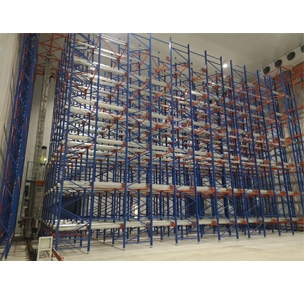
All shuttle systems require appropriate racking structures. Pallet shuttles use deep-lane racking with rails. Four-way shuttles require a grid structure where rails run in both directions at each level. Standard pallet racking can sometimes be retrofitted for pallet shuttles, but 4-way shuttle grids are usually purpose-built.
WMS and WCS
Two software layers control automated warehouses. The Warehouse Management System (WMS) handles inventory data, order processing, and slotting strategies. The Warehouse Control System (WCS) translates WMS instructions into specific movements for shuttles, cranes, and conveyors.
Choosing Between Technologies
The right technology depends on a few basic factors:
Many warehouses combine technologies. A typical configuration might use pallet shuttles for bulk raw materials, ASRS for finished goods buffer storage, and 4-way shuttles for order picking. Each system handles the part of the workflow it does best.
Implementation Considerations
Automation projects do not require shutting down the entire warehouse. Phased implementation is standard practice. One zone is automated at a time while other zones continue normal operations.
Training requirements vary. Operators typically learn basic interfaces and troubleshooting within days or weeks. Maintenance tasks include visual inspections, rail cleaning, and battery monitoring. Most systems include predictive alerts that indicate when components need attention.
Common Misconceptions
Several misconceptions circulate about warehouse automation. Automation does not necessarily eliminate jobs. It changes job content, often shifting workers from manual handling to system monitoring or maintenance roles. Automation is not only for large corporations. Many small and medium-sized warehouses use pallet shuttle or 4-way shuttle systems scaled to their volume. Automation does not require new construction. Retrofits into existing buildings are common.
Summary
Warehouse automation offers practical solutions to common operational pressures. ASRS, pallet shuttles, and 4-way shuttles each address different storage and retrieval needs. Racking structures and software systems complete the picture. The right combination depends on ceiling height, load types, SKU counts, and throughput requirements.
For specific guidance, consult a qualified automation provider. Site assessments and data analysis help determine which technologies fit a given operation.


 English
  Español
  português
  العربية
  tiếng việt
  ไทย
ไทย  Indonesia