When companies invest in warehouse automation, they often assume they must choose between different technologies. For storage and retrieval, the decision frequently comes down to two options: the 4-way shuttle (also written as 4 way shuttle) and the pallet shuttle. But this framing misses a larger opportunity. These two technologies are not competitors. They are complementary tools designed for different parts of the warehouse workflow.
This article explains how each technology works, where each performs best, and how they can be combined within a single automated facility.
What Is a 4-Way Shuttle?
A 4-way shuttle (or 4 way shuttle) is a motorized vehicle that runs on a grid of rails installed within a racking structure. It is called a four-way shuttle because it can move in four directions: forward, backward, left, and right. This ability allows the shuttle to change aisles and access any location within the grid without needing a separate transfer car.
Four-way shuttles are typically used for handling totes, cases, or individual items. They operate on multiple levels, with lifts moving shuttles between levels. Multiple four-way shuttles can work simultaneously within the same grid, with software managing traffic and task allocation.
In a warehouse automation context, four-way shuttles are often paired with goods-to-person picking stations. Instead of workers walking to find products, the shuttles bring containers directly to stationary workstations. This arrangement reduces walking time, improves picking accuracy, and allows workers to focus on value-added tasks.
What Is a Pallet Shuttle?
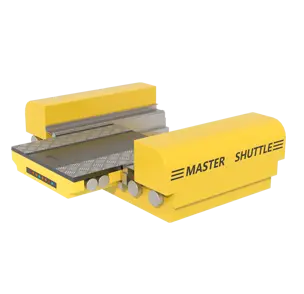
A pallet shuttle is a rail-guided cart designed to move full pallets within deep storage lanes. Unlike a four-way shuttle, a traditional pallet shuttle moves in only one direction: forward and backward along a single lane. A forklift places a pallet at the lane entrance, and the shuttle carries the pallet to the deepest available position. For retrieval, the shuttle fetches the requested pallet and brings it back to the lane entrance.
Pallet shuttles are designed for density. By eliminating the need for wide forklift aisles throughout the storage area, they allow warehouses to store significantly more pallets within the same footprint. A pallet shuttle system can increase storage density by 60 to 100 percent compared to traditional selective racking.
In warehouse automation projects, pallet shuttles are commonly used for bulk storage, raw materials, finished goods buffers, and cold storage applications where reducing door openings also lowers energy costs.
How Do They Differ?
When to Use a 4-Way Shuttle
A 4-way shuttle system is well-suited for warehouses with thousands of SKUs, high order variability, or e-commerce fulfillment. The technology excels in environments where many different items must be retrieved quickly and accurately.
Common applications for four-way shuttles include:
E-commerce fulfillment centers handling many small orders
Retail distribution warehouses storing a wide variety of products
Spare parts logistics for automotive or industrial equipment
Pharmaceutical warehouses requiring precise inventory tracking
In these settings, the flexibility of the four-way shuttle justifies the higher per-position cost compared to denser but less flexible alternatives.
When to Use a Pallet Shuttle
A pallet shuttle system is well-suited for warehouses where storage density is the primary concern. It works best when inventory moves in full pallet quantities and when access frequency is moderate.
Common applications for pallet shuttles include:
Cold storage facilities, where energy savings from reduced door openings are significant
Food and beverage warehouses storing full pallets of ingredients or finished goods
Raw material storage for manufacturing plants
Seasonal or slow-moving inventory that does not require frequent access
In these settings, the density gains from pallet shuttles often outweigh the lower flexibility.
How They Work Together: A Hybrid ASRS Approach
Many advanced warehouse automation projects combine both technologies within a single facility. In this hybrid model, pallet shuttles and four-way shuttles serve different roles in the same workflow.
A typical hybrid configuration might look like this:
Bulk receiving: Incoming full pallets are stored in a pallet shuttle system. This provides dense storage for raw materials or finished goods.
Replenishment: When the four-way shuttle grid needs inventory, pallets are retrieved from the pallet shuttle system and moved to a depalletizing area. Cases or totes are removed from the pallet and transferred to the four-way shuttle grid.
Order picking: The four-way shuttles retrieve specific containers from the grid and deliver them to goods-to-person picking stations. Workers pick the required quantities for each order.
Outbound: Picked items are packed and shipped. Empty containers are returned to the four-way shuttle grid for reuse.
This hybrid model combines the density of pallet shuttles with the flexibility of four-way shuttles. The pallet shuttle system handles the bulk, low-frequency part of the inventory. The four-way shuttle system handles the high-frequency, high-variability part of the workflow.
Where Does ASRS Fit?
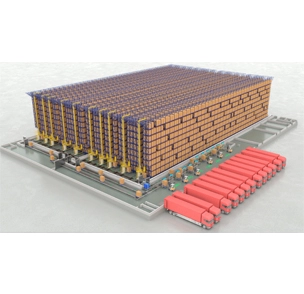
ASRS (Automated Storage and Retrieval Systems) is another technology often mentioned alongside shuttles. ASRS uses stacker cranes that travel within fixed aisles to store and retrieve pallets from high-bay racking.
ASRS is best suited for warehouses with very high ceilings, typically 15 meters or taller, and for applications requiring very high throughput. In a hybrid facility, ASRS might serve as the primary buffer for finished goods, with pallet shuttles handling raw materials and four-way shuttles handling order picking.
The choice between ASRS, pallet shuttles, and four-way shuttles depends on building height, throughput requirements, and inventory characteristics.
Factors to Consider When Choosing
When planning a warehouse automation project, several factors should guide technology selection:
Building height: ASRS requires tall buildings. Shuttles work well in moderate heights.
Load type: Pallet shuttles are for full pallets. Four-way shuttles are for totes and cases.
SKU count: Many SKUs favor four-way shuttles. Fewer SKUs may favor pallet shuttles or ASRS.
Throughput: High throughput may require ASRS or larger shuttle fleets.
Access frequency: Frequently accessed items benefit from four-way shuttle flexibility. Infrequent items can be stored in pallet shuttles or ASRS.
Cold storage: Pallet shuttles are common due to density and energy benefits.
Conclusion
A 4-way shuttle (or 4 way shuttle) and a pallet shuttle serve different purposes in warehouse automation. The four-way shuttle provides flexibility for high-SKU, high-variability order picking. The pallet shuttle provides density for bulk storage. They are not mutually exclusive. In many facilities, they work together as part of a complete automated workflow.
ASRS adds another option for tall buildings and high-throughput pallet storage. The right solution often combines multiple technologies rather than selecting just one.
For warehouses considering automation, a site assessment and data analysis can determine the optimal mix of four-way shuttles, pallet shuttles, and ASRS for the specific operation.


 English
  Español
  português
  العربية
  tiếng việt
  ไทย
ไทย  Indonesia