In the field of automated warehousing, the stacker crane system (AS/RS) is the most time-tested, technically mature, and widely applied pallet-level automated storage solution. Despite the rapid development of dense storage technologies such as four-way shuttles and pallet shuttles in recent years, stacker crane systems remain irreplaceable in high-bay, high-throughput, and regular-shaped warehouse scenarios.
This article provides a professional analysis of stacker crane systems from four dimensions: technical architecture, core parameters, applicable scenarios, and selection logic.
I. System Architecture and Operating Principles
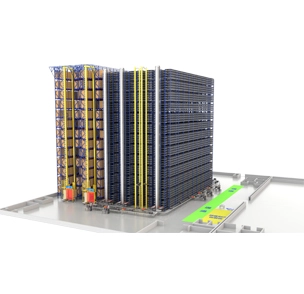
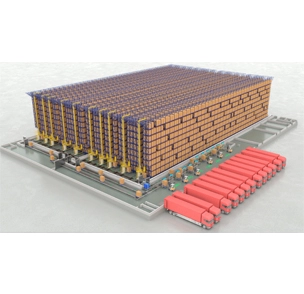
The stacker crane system (AS/RS) consists of aisle stacker cranes, horizontal conveying systems, racking systems, and WMS/WCS control systems. The stacker crane operates within a fixed aisle, moving horizontally along the aisle (X-axis) while simultaneously traveling vertically along the racking (Y-axis), using a telescopic fork to store and retrieve pallets.
Its core operating principle is: after receiving instructions from WMS/WCS, the stacker crane automatically travels to the designated storage location, uses its fork to retrieve the pallet from the racking or place it into the racking, then returns to the conveyor interface at the aisle end, where the conveyor line transports the goods to the outbound station or the next process.
Master's stacker crane products adopt internationally advanced technologies including analog closed-loop speed control, S-curve acceleration/deceleration, and variable frequency control, ensuring stability and positioning accuracy during high-speed operation.
II. Core Parameters and Technical Features
Master's stacker crane system specifications are as follows:
1. High Speed and Efficiency
A single stacker crane can handle 40-60 pallets per hour, suitable for scenarios with relatively stable inbound/outbound rhythms. Through double-deep fork design, storage capacity can be increased without adding aisles.
2. High Reliability
Stacker crane systems have undergone decades of technological evolution, with mature structures and high reliability. Master's products maintain stable operation even in harsh environments such as cold storage, with minimal risk of warehouse operation paralysis due to equipment failure.
3. Ultimate Utilization of Vertical Space
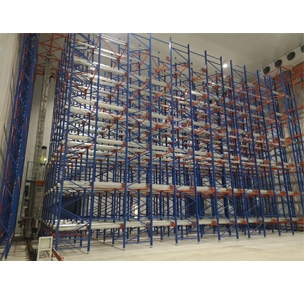
Stacker crane warehouses can reach heights exceeding 40 meters, achieving several times the storage capacity of flat warehouses on limited land. In a food cold storage project, Master implemented a 12-level beam racking design, completing full system construction of 13,376 pallet positions.
III. Applicable Warehouse Types and Typical Scenarios
Stacker crane systems are suitable for the following warehouse types:
Typical Industry Applications:
Manufacturing: Raw material warehouses, finished goods warehouses, achieving automated production line feeding
Third-Party Logistics: Regional distribution centers, high throughput, high reliability
Food & Beverage: Finished pallet storage, high-volume standardized operations
Cold Storage: Automated storage in low-temperature environments, reducing manual entry
Master has accumulated rich implementation experience in stacker crane projects and has achieved full-system integrated delivery for multiple automation projects in overseas markets including Malaysia, with project heights exceeding 30 meters.
IV. Comparison with Other Technology Routes
V. Selection Recommendations
VI. Technology Evolution and Future Trends
Stacker crane systems are not a stagnant technology. In recent years, Master has continued to optimize in the following directions:
High-Speed: Increasing horizontal speed to over 180 m/min through variable frequency control and S-curve acceleration/deceleration
Intelligence: Combining digital twin technology for real-time monitoring and predictive maintenance of equipment status
Flexibility: Double-deep and variable-pitch fork designs to enhance adaptability to multiple pallet specifications
Energy Efficiency: Energy regeneration systems recover electrical energy during braking, reducing operating energy consumption
As one of the few companies in the industry with full-chain independent R&D capabilities covering racking systems, various shuttle types, stacker cranes, lifts, conveyor lines, and WMS/WCS software, Master can provide stacker crane, shuttle, and other technology solutions for different business scenarios, supporting customized design and full-system integrated delivery. The company holds over 40 invention and utility model patents and has successfully implemented and delivered nearly 100 automated warehouse systems to the market.


 English
  Español
  português
  العربية
  tiếng việt
  ไทย
ไทย  Indonesia