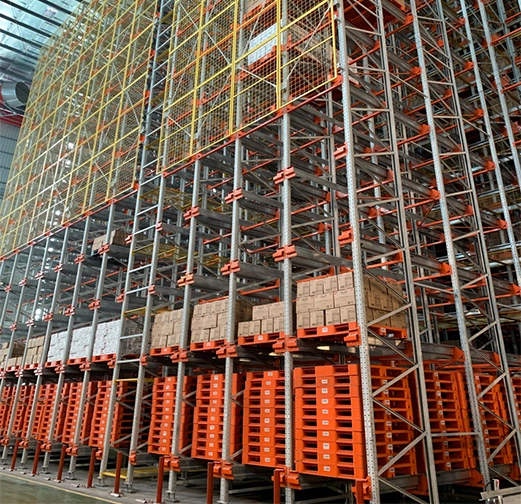
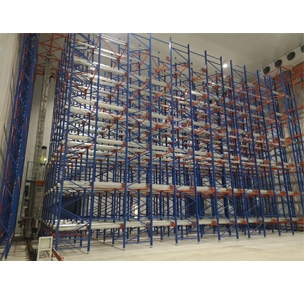
In the engineering planning of stacker crane systems (AS/RS), storage density and system throughput often form a pair of contradictions. Increasing rack height can boost vertical storage capacity, but horizontal density improvement has long been constrained by the number of aisles—each aisle occupies valuable floor space that cannot be used for storage.
The emergence of Double-Deep Fork technology provides a compromise for this contradiction. It allows the stacker crane to store two rows of pallets on each side of the same aisle, nearly doubling storage capacity without adding aisles.
I. Technical Principles and Structural Features
The core of a double-deep stacker crane lies in the telescopic fork travel design. A standard single-deep fork only needs to place the pallet into the first row, while a double-deep fork requires sufficient telescopic travel to pass over the first row and precisely place the pallet into the second row deep position.
Structurally, double-deep stacker crane forks typically adopt a three-stage or four-stage telescopic structure, achieving longer operational travel through progressive extension of multi-stage guide rails. In Master's stacker crane products, the forks use European imported brands, paired with SEW motor drives and Siemens control assemblies, maintaining operational stability while ensuring long-travel precision.
For horizontal drive, Master adopts German Demag travel mechanisms, achieving horizontal travel speeds of up to 220 m/min, horizontal acceleration of 0.5 m/s², and positioning accuracy within ±5mm. These performance metrics are particularly critical for double-deep operations—the fork must maintain precise positioning for second-row pallet positions even at higher travel speeds.
II. Quantitative Logic of Density Improvement
The core value of double-deep design lies in trading depth for density. Taking a standard aisle as an example:
This means that within the same warehouse footprint, a stacker crane system with double-deep forks can increase storage capacity by nearly 100%. For urban locations with high land costs or existing warehouses with expansion constraints, this improvement has significant economic value.
Of course, double-deep does not come without trade-offs. The access efficiency of second-row positions is lower than first-row positions—when retrieving a pallet from the second row, the stacker crane must first move the first-row pallet out (or possess the capability to directly retrieve across depths, depending on fork design). Therefore, double-deep solutions are more suitable for storage scenarios with relatively stable SKUs and moderate inbound/outbound frequency, rather than high-frequency split-case picking environments.
III. Applicable Scenarios and Selection Boundaries
Double-deep stacker crane systems have clear advantages in the following scenarios:
1. Density Supplement for High-Bay Warehouses
For warehouses whose height has reached building limits and cannot increase capacity through "upward development," double-deep is an effective means of tapping potential in the horizontal direction. In cold storage projects, Master has adopted a 12-level beam racking design, completing full-system construction of 13,376 pallet positions. Double-deep design can further compress aisle proportion in similar projects.
2. High-Volume Storage with Stable SKU Categories
In scenarios such as manufacturing raw material warehouses and food & beverage finished goods warehouses, where SKU counts are relatively limited and single-category batch sizes are large, the density advantages of double-deep can be fully utilized, while the efficiency trade-off of second-row access has controllable impact on overall operations.
3. Hybrid Deployment with Single-Deep
In actual planning, not all pallet positions require double-deep configuration. A common strategy is: single-deep for high-turnover items, double-deep for low-frequency items, achieving a balance between density and efficiency. Master's stacker crane systems support single-deep and double-deep hybrid design, enabling customized layouts based on client inbound/outbound frequency distribution.
IV. Density Comparison: Double-Deep Stacker Cranes vs. Four-Way Shuttles
When discussing storage density, double-deep stacker cranes and four-way shuttles are often compared within the same framework. Their density improvement logics differ:
The density improvement of double-deep stacker cranes is local and linear—each aisle independently increases depth; the density improvement of four-way shuttles is systemic and grid-based—improving overall utilization by eliminating fixed aisles and sharing through a grid. In high-bay scenarios exceeding 20 meters, double-deep stacker cranes remain the more mature density solution; in medium-to-low bay scenarios, the flexibility advantages of four-way shuttles are more prominent.
V. Key Selection Decision Points
As one of the few companies in the industry with full-chain independent R&D capabilities covering stacker cranes, shuttles, racking systems, and WMS/WCS software, Master can provide customized solutions for scenarios with different density requirements and efficiency needs. The company's stacker crane products adopt double-column stability-enhanced structures and are designed for low-temperature resistance, making them suitable for cold storage applications.
For companies planning high-bay warehouses, double-deep forks are not a default option, but a strategic choice based on the trade-off between density and efficiency. Understanding their technical boundaries and applicable scenarios helps make more precise decisions in automation solution planning.


 English
  Español
  português
  العربية
  tiếng việt
  ไทย
ไทย  Indonesia