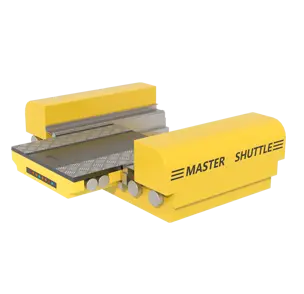
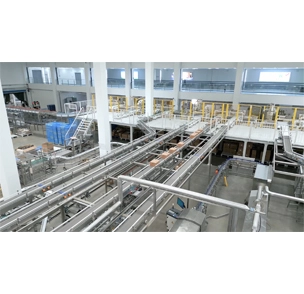
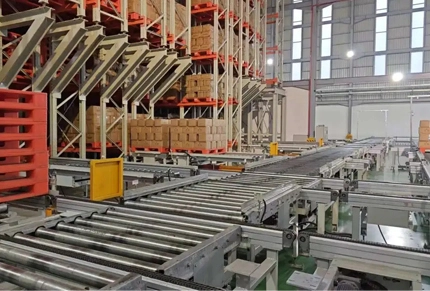
In the field of automated warehousing systems, Tianjin Master Logistics Equipment Co., Ltd. has built a complete product portfolio centered on Stacker Cranes (AS/RS), 4-Way Shuttles, and Pallet Shuttles. Although these three products all belong to pallet-level automated storage equipment, they differ fundamentally in applicable scenarios, core problems solved, and technical approaches. This article provides an in-depth analysis from three dimensions: warehouse type suitability, customer pain points, and typical applications.
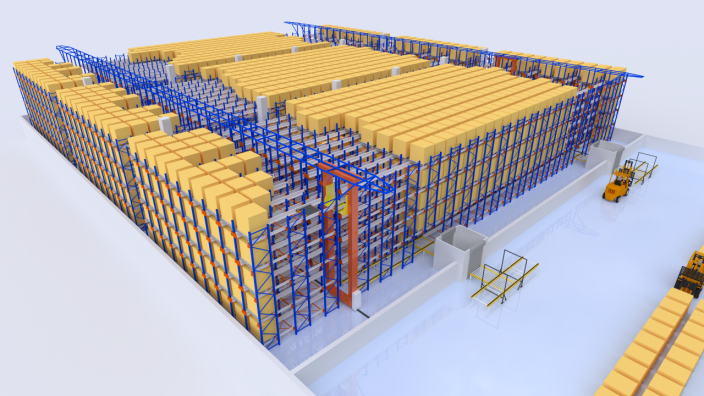
I. Stacker Crane System (AS/RS): Efficiency Leader for High-Bay, Regular-Shaped Warehouses
Applicable Warehouse Characteristics
The stacker crane system is the traditional mainstay solution for automated three-dimensional warehouses. Its typical applicable conditions include:
Sufficient building height: AS/RS warehouses typically require clear heights above 15 meters, with maximums reaching over 40 meters. A stacker crane warehouse project delivered by Master in Malaysia exceeded 30 meters in height-5, demonstrating the technology's capability to utilize vertical space.
Regular layout: Stacker cranes operate within fixed aisles, requiring regular warehouse floor plans with straight, unobstructed aisles. Irregular buildings or dense column grids significantly increase system design and construction difficulty.
Relatively stable SKU profile: Once an AS/RS system is built, the number of aisles is fixed. Flexibility to add or remove SKUs or adjust storage slotting is low, making it more suitable for scenarios with relatively stable product categories.
Core Problems Solved
1. Waste of vertical space
Traditional flat warehouses or low-bay racking waste significant overhead space. Stacker crane systems "build upward," achieving several times the storage capacity of flat warehouses on limited land. In a food cold storage project, Master implemented a 12-level beam racking design, completing full system construction of 13,376 pallet positions, maximizing land value through high-bay storage.
2. High-volume, high-frequency inbound/outbound operations
Although single-stacker-crane operation models are limited by single-aisle throughput ceilings, a single stacker crane can still handle 40-60 pallets per hour-4, suitable for scenarios with relatively stable inbound/outbound rhythms.
3. Long-term stable operation
Technical maturity and high reliability are the core advantages accumulated by stacker crane systems over decades of development. Stacker crane systems ensure continuous and stable cold storage operations, with minimal risk of warehouse operation paralysis due to equipment failure-4.
Typical Industry Applications
Master has accumulated rich implementation experience in AS/RS projects. Its products adopt internationally advanced technologies including analog closed-loop speed control, S-curve acceleration/deceleration, and variable frequency control-10, with applications across multiple industries and full-system integrated delivery in overseas markets-5.
II. 4-Way Pallet Shuttle System: Flexible Expert for Complex, Irregular-Shaped Warehouses
Applicable Warehouse Characteristics
The 4-way shuttle is one of the fastest-growing automated storage technologies in recent years, with applicable conditions that complement stacker cranes:
Limited building height (8-15 meters): For warehouses with clear heights below 15 meters, stacker cranes struggle to leverage their advantages, while 4-way shuttles are an ideal choice.
Irregular floor plans: Whether L-shaped, U-shaped, or with misaligned columns, 4-way shuttles can flexibly adapt. Industry analysis indicates that 4-way pallet shuttles possess X-axis and Y-axis material handling capabilities with high flexibility, particularly suitable for irregular warehouse layouts-4.
Multi-level warehouses or retrofits of older buildings: Traditional industrial multi-level warehouses have limited floor heights and dense column grids. 4-way shuttle systems require minimal civil works and have become a preferred solution for automated retrofits-1. A project Master undertook in 2018 at an old textile mill is a typical case—the warehouse had low ceilings and dense columns, and the 4-way shuttle solution successfully achieved automated retrofitting-8.
Core Problems Solved
1. Automation retrofit challenges for existing warehouses
Many existing warehouses were not designed for automation, with insufficient height, irregular shapes, and dense column grids. 4-way shuttles can be rapidly deployed without major modifications, making them the "optimal solution" for old warehouse automation-1.
2. Trade-off between storage density and access flexibility
Traditional dense storage solutions (such as drive-in racking) offer high density but poor access flexibility. AS/RS offers flexible access but lower storage density compared to dense storage solutions. 4-way shuttles balance both high-density storage and random access capability within a single system. The equipment can move in both the X and Y axes of the racking, freely switching directions to reach any designated position.
3. Elastic demand for significant fluctuations in inbound/outbound frequency
The throughput capacity of 4-way shuttle systems can be flexibly adjusted by increasing or decreasing the number of shuttles—one shuttle can cover the entire warehouse during low-frequency periods, while dozens can operate collaboratively during peak times, achieving flexible scheduling.
Technical Features and Typical Applications
Master's 4-way shuttle products adopt a mechanical lifting structural design and PLC control system technical path. Although this route has higher costs than microcontroller-based solutions, it offers better reliability and maintainability in operation. The company continuously optimizes critical components including shuttle structural design, motors, and lifts, and has improved path planning capabilities through in-depth research into scheduling algorithms, solving multi-vehicle intersection and complex working condition path planning issues.
In the Inner Mongolia Jihong Packaging project, Master deployed 32 intelligent 4-way shuttles, achieving multi-vehicle same-level operation (9 shuttles running simultaneously per level) 24/7, with turnover efficiency improved by approximately 40%, storage space utilization increased 2-3 times, and inventory accuracy exceeding 99%.
III. Pallet Shuttle (Parent-Child) System: Cost-Effective Choice for Ultimate Storage Density
Applicable Warehouse Characteristics
The pallet shuttle (parent-child) system, like the 4-way shuttle, belongs to dense storage technology, but with different applicable scenarios:
Moderate clear height (6-15 meters): Suitable for medium-height standard warehouses.
Regular layout, linear aisles: Parent-child systems achieve ultimate density in regular layouts, but have weaker adaptability to irregular warehouses compared to 4-way shuttles.
Relatively uniform product categories: Suitable for high-volume, low-SKU storage scenarios such as bulk commodities and seasonal stockpiling.
Core Problems Solved
1. Pursuit of ultimate space utilization under land cost pressure
Parent-child systems eliminate forklift aisles, storing more pallets within the same footprint. Compared with AS/RS, this system offers stronger storage capacity design and scalability. The child shuttles use servo motors for precise positioning, featuring fast response and accurate positioning-10.
2. Automation upgrades for medium-to-low frequency inbound/outbound scenarios
For scenarios with lower inbound/outbound frequency but large storage volumes (such as cold storage buffers or seasonal stockpiling), parent-child systems achieve automated storage at lower cost, avoiding high-cost solutions designed for "high-frequency" scenarios.
Typical Industry Applications
IV. How to Choose: A Decision Reference Table
V. Master's System Integration Capabilities and Global Presence
The three product types are not mutually exclusive. In actual projects, Master often combines them according to customer needs—using stacker crane systems as high-bay buffers, 4-way shuttle systems for high-flexibility picking zones, and pallet shuttle systems for slow-moving or seasonal inventory storage.
Master has a complete product line covering core equipment including racking, shuttles, and stacker cranes, as well as self-developed WMS/WCS software systems. In 2024, the company obtained the patent for "Digital Twin-based 4-Way Shuttle Logistics Modeling Method, System, and Medium," applying digital twin technology to efficiently model and optimize logistics processes, and has integrated 3D digital twin control and display systems into projects, enabling real-time display of equipment operating status and performance data.
Master has been recognized as a "National Specialized and Sophisticated 'Little Giant' Enterprise"-5. As of 2025, it has successfully implemented and delivered nearly 100 automated warehouse systems to the market, achieving full-system integrated delivery for multiple automation projects in overseas markets including Malaysia-5. In 2024, Master signed a strategic cooperation memorandum with Malaysian publicly-listed company Panda Eco System Berhad, introducing integrated logistics and supply chain solutions to the local market-2.
Whether facing the efficiency demands of high-bay warehouses, the flexibility needs of irregular warehouses, or the density requirements of ultimate storage, Master can provide matching automated solutions.


 English
  Español
  português
  العربية
  tiếng việt
  ไทย
ไทย  Indonesia