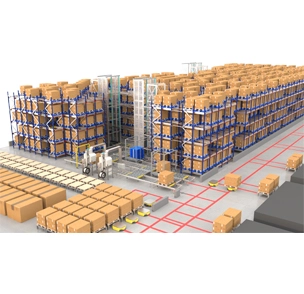
When people discuss warehouse automation, the attention often goes to the moving parts: shuttles, stacker cranes, and robots. But these machines cannot function without the structure that supports them. Racking is the backbone of any automated storage system.
This article explains the types of racking used with different automation technologies and what makes them suitable for each application.
Why Racking Matters in Automation
In a manual warehouse, racking primarily needs to support static loads. A forklift places a pallet on a beam, and the beam holds the weight. In an automated warehouse, racking has additional requirements. It must guide moving equipment precisely. It must withstand dynamic forces from accelerating and decelerating shuttles or cranes. It must maintain alignment within tight tolerances over years of operation.
Standard pallet racking is not always sufficient for these demands.
Racking for Pallet Shuttles
Pallet shuttles operate within deep storage lanes. The racking for this application is typically a drive-in style structure modified with rails. The rails run along the length of each lane, guiding the shuttle as it moves pallets in and out.
Key features of pallet shuttle system racking include:
Integrated rails: Steel rails are attached to the racking structure at each storage level.
Deep lanes: Lanes can extend 20 pallets deep or more, depending on the application.
FIFO or FIFO configuration: Racking can be designed for first-in-first-out flow, with loading on one end and retrieval on the other, or for last-in-first-out, with loading and retrieval from the same end.
Structural bracing: Because shuttles apply lateral forces when starting and stopping, the racking requires additional bracing compared to static storage.
Pallet shuttle racking is commonly used in cold storage, food and beverage warehouses, and any facility where storage density is a primary concern. The racking itself is typically made from high-strength steel and designed to operate at temperatures as low as -30°C.
Racking for 4-Way Shuttles
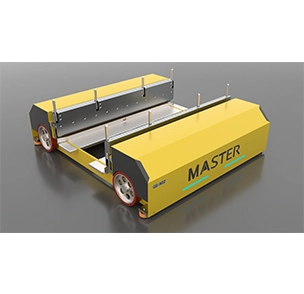
Four-way shuttles operate on a grid. The racking for 4-way shuttle systems is more complex than pallet shuttle racking because it must support movement in two directions at each level.
Features of 4-way shuttle racking include:
Bi-directional rail grid: Rails run both longitudinally and transversely at each level.
Multiple levels: Shuttles move between levels using dedicated lifts, not internal ramps.
Precision alignment: The grid must be installed with tight tolerances to ensure smooth shuttle movement. Typical alignment requirements are within a few millimeters across the entire grid.
Access points: The grid includes openings for lifts and picking stations.
Four-way shuttle racking is common in e-commerce fulfillment centers, retail distribution warehouses, and spare parts logistics. It is designed for high-frequency access to many different stock keeping units (SKUs).
Racking for ASRS
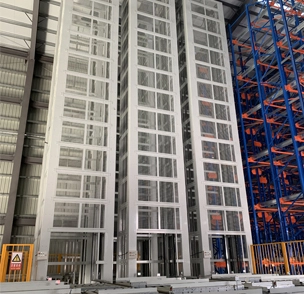
ASRS (Automated Storage and Retrieval Systems) use stacker cranes that travel within fixed aisles. The racking for ASRS is typically tall, often exceeding 20 meters and sometimes reaching 45 meters.
Characteristics of ASRS racking include:
High-bay design: Racking is built to maximize vertical space. The structure must withstand wind loads and seismic forces, especially for outdoor or very tall installations.
Integrated crane rails: Rails for the stacker crane run along the floor and at the top of the racking.
Precise alignment: The racking must be installed with extreme precision. Even small misalignments can cause crane positioning errors.
Load-bearing capacity: Each rack structure must support not only stored pallets but also the dynamic forces of the crane moving within the aisle.
ASRS racking is used in large-scale distribution centers, manufacturing plants, and any facility where land is expensive and vertical storage is necessary.
Retrofitting Existing Racking
Some warehouses ask whether existing standard pallet racking can be used with automation. The answer depends on the technology.
For pallet shuttles: Retrofitting is sometimes possible. The existing racking must be structurally sound, and rails must be added to each lane. A site assessment determines feasibility.
For 4-way shuttles: Retrofitting existing racking is generally not practical. The grid structure is specialized and typically requires new installation.
For ASRS: Retrofitting is not possible. ASRS racking is purpose-built and cannot be converted from standard racking.
Material and Finish Considerations
Racking for automated systems is typically made from structural steel. For cold storage applications, special considerations apply:
Steel grade: Low-temperature steel grades maintain toughness at freezing temperatures.
Surface finish: Hot-dip galvanizing or specialized coatings prevent corrosion in high-humidity environments.
Fasteners: Bolts and connections must be rated for the operating temperature range.
For dry, ambient warehouses, powder-coated finishes are common and sufficient for most applications.
Maintenance of Automated Racking
Racking in automated warehouses requires periodic inspection. Automated systems subject the structure to dynamic loads that static racking does not experience.
Typical inspection items include:
Rail alignment and wear
Bolted connection tightness
Signs of impact or deformation
Corrosion, especially in cold storage
Floor anchorage integrity
Most manufacturers recommend annual professional inspections for automated racking systems.
Summary
Racking is not a passive component in automated warehouses. It is an active part of the system, guiding equipment and withstanding dynamic forces. Pallet shuttle racking prioritizes dense storage with deep lanes and rails. Four-way shuttle racking requires a bi-directional grid for flexible movement. ASRS racking must be tall, precise, and capable of supporting both pallets and moving cranes.
Understanding these differences helps in planning an automation project. The racking must be matched to the technology, not treated as an afterthought.
For warehouses considering automation, a site assessment can determine whether existing racking can be used or if new racking is required.


 English
  Español
  português
  العربية
  tiếng việt
  ไทย
ไทย  Indonesia