Three numbers size a warehouse elevator before anything else is discussed: rated load, lift height with the number of stops, and the cycle the floor schedule actually demands. Get those three fixed and the remaining decisions — door type, temperature rating, control interface, pit depth — become comparisons, not open questions. This guide covers freight and cargo lifts for automated warehouses (not passenger elevators), how a lift sits between conveyors and shuttles on a multi-floor flow, freezer-rated options down to −20 °C, and how to estimate how many lifts a building needs. Specifications cited here come from the published product page: 800 kg rated load and −20 °C to +50 °C operating range.
Warehouse elevators capacity speed and multi floor flow
Naming First: Elevator, Cargo Lift, Goods Lift, Freight Elevator
The four names describe the same machine class with different emphasis, and the drift in wording is the main reason buyers land on a page and leave without an answer. "Warehouse elevator" and "warehouse freight elevator" are the common North American terms for a lift moving palletized or unitized goods between floors. "Cargo lift" and "goods lift" are the more frequent phrasings in Asia and Europe for the same equipment, often implying a simpler cabin without finished interior walls. A "VRC" (vertical reciprocating conveyor) is a related but narrower category — a mechanical lift that moves material but not an operator.
For sourcing, the label matters less than three declarations the supplier must make in writing: the rated load in kilograms, the lift height and number of floors served, and whether the unit is rated for the temperature zone it will stand in. Everything else follows from those.
Four Vertical Devices and What Each Can Carry
Automated warehouses use four device families for vertical movement, and they are not interchangeable.
Vertical devices by typical duty in an automated warehouse
Device
Typical load
Typical speed
Where it fits
Freight / cargo elevator
Pallet loads, the rated load on the datasheet (Master's published rating: 800 kg)
Moderate, servo-controlled
Floor-to-floor transfer of whole pallets between conveyors or staging areas
Servo vertical lift module
Pallet or tote, per datasheet
Continuously variable
The default inside automated lines, because positioning is repeatable and the platform can dock to a conveyor
VRC
Material only, no rider
Low to moderate
Mezzanine or low-rise duty where no operator rides along
Scissor lift table
Short travel only
Slow
Height adjustment at a fixed station, not floor-to-floor transport
The reason automated lines standardize on servo lifts is control. Master's warehouse elevators use servo stepless speed regulation with a force-balance operating mode, which means the platform approaches each floor at reduced speed and docks without the operator nudging it into position. That docking behavior is what lets a lift hand a pallet to a conveyor without an attendant.
Published specification for the referenced unit: 800 kg rated load, −20 °C to +50 °C operating range. Source: warehouse elevators product page.
Three Numbers That Size a Lift
Rated load comes first, but it is not the number most teams get wrong.
Rated load.
Weigh the heaviest unit load that will ever ride the platform, including the pallet and any pallet-inverting or clamping attachments, then add margin for a forklift bump during manual loading. If that figure exceeds the datasheet rating, the specification changes — an 800 kg rating does not stretch to a 1,200 kg pallet.
Lift height and stops.
A lift serving two floors with one landing behaves differently from one serving four floors with three intermediate landings, even at identical travel height. Every additional stop adds door cycles and positioning time to the round trip, so the same physical rise supports fewer cycles per hour as the stop count grows.
Speed and cycle demand.
Platform speed matters only in relation to the cycle the floor schedule demands. A lift that must complete a round trip every 90 seconds spends most of its time loading, positioning and docking — not traveling. Before paying for a faster platform, confirm the floor schedule actually frees up the extra seconds. In most multi-floor warehouses the binding constraint is door cycles and hand-off time, not travel speed.
The Lift as a Node in an Automated Flow
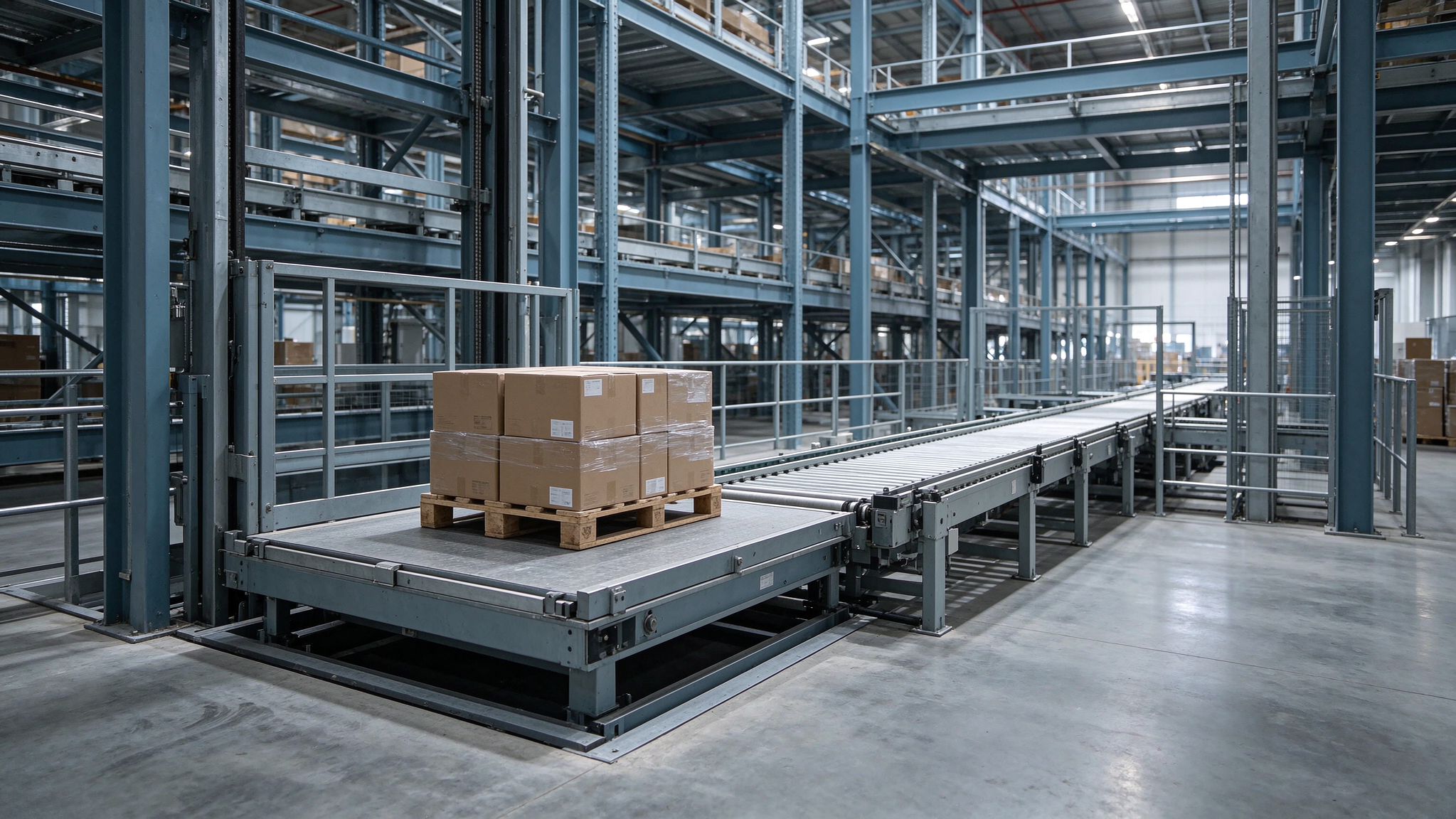
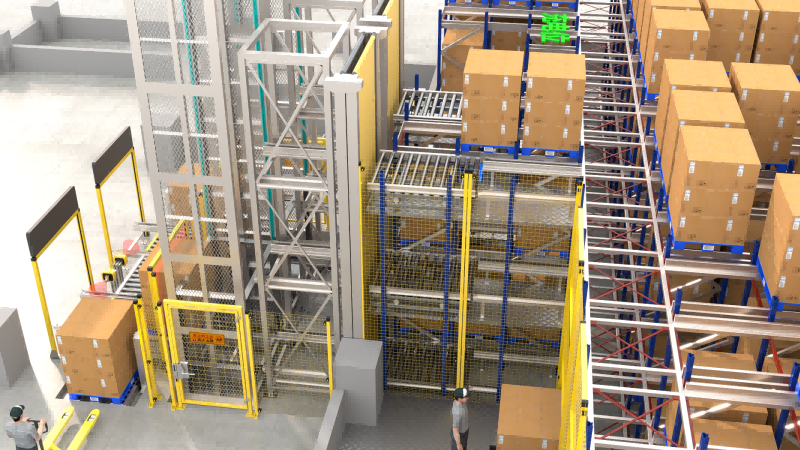
In an automated multi-floor warehouse, the lift is not a standalone machine — it is a node that must hand off pallets in both directions without creating a queue. Three interface conditions decide whether that works.
First, a buffer position on each side. A pallet arriving from a conveyor leg has to wait somewhere while the lift finishes its previous cycle. The buffer depth sets how long the upstream equipment can run before it stalls; sizing it is a flow calculation, not a catalogue choice.
Second, an agreed hand-off direction. The lift platform either docks level with a conveyor so the pallet rolls across, or it presents to a shuttle aisle where the vehicle picks the pallet off the platform. Both work; mixing them at one landing does not. Pick one hand-off geometry per landing and hold it.
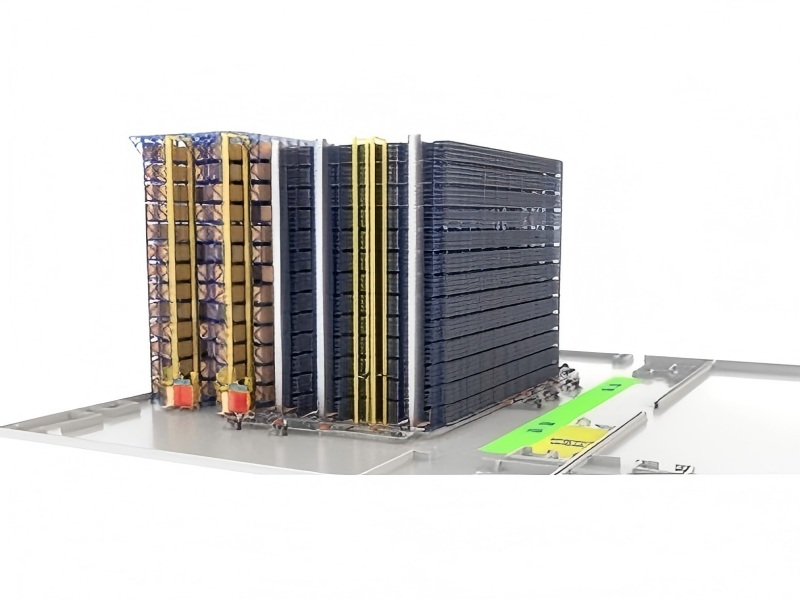
Third, a single owner of the call logic. The warehouse control system decides which floor calls the lift, in what order, and what happens when two calls compete. In a project combining four-way shuttles and lifts — such as Master's mixed-warehouse case with nine four-way carts and four elevators — the WCS schedules both fleets against the same lift queue, so the lift never waits idle while a shuttle is still traveling to it.
On the conveyor side, the hand-off is a level docking problem: see how an automated sorting conveyor system presents pallets at transfer height. On the shuttle side, the vehicle does the final approach; see the multi level shuttle for the on-tier leg of that flow.
Freezer and Low-Temperature Operation
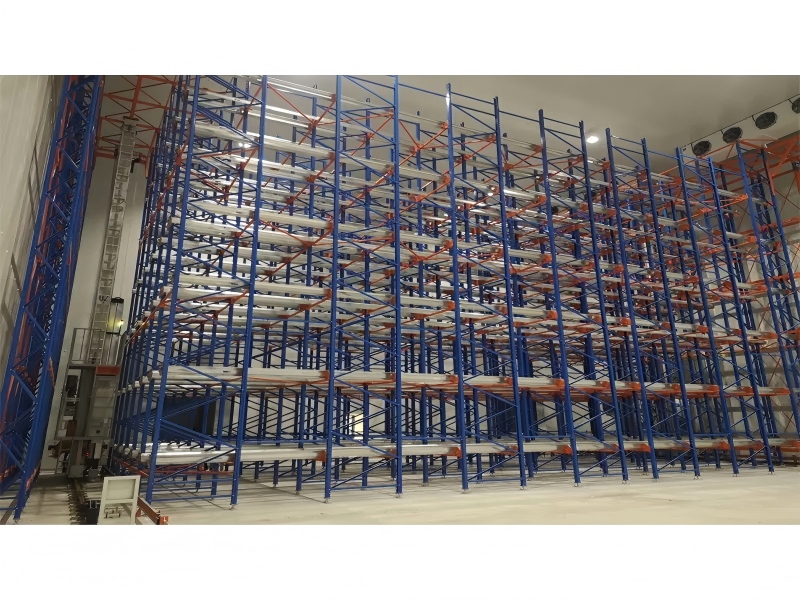
A lift that works at +20 °C will not necessarily work at −20 °C, and the differences are specific: condensation on the platform and rails during door cycles, grease viscosity that changes with temperature, and electronics that must be rated for the zone they stand in. Master's published operating range covers −20 °C to +50 °C, which places the standard unit inside a freezer rather than merely beside it.
Selection for low temperature is a separate exercise, not a checkbox. Confirm where the lift stands — fully inside the freezer, straddling the door line, or in the ambient anteroom — because the worst condition is the straddling case, where the platform cycles between two climates every trip and condensation forms on every cold surface it touches. Heated or low-temperature-rated lubrication, enclosure heating for the control cabinet, and drainage around the pit all follow from that answer. For the storage side of the same buildings, cold-structure choices are covered separately under cold storage racking and cold chain warehousing.
How Many Lifts a Multi-Floor Warehouse Needs
Estimate the count from the floor schedule, not from the floor area. The method:
Count the pallet movements each floor must send or receive per hour at peak, split by direction. A floor that receives 40 inbound pallets and ships 20 per hour generates 60 lift transactions, not 40.
Convert to round trips. One round trip serves two transactions at best; usually fewer, because inbound and outbound peaks rarely align.
Subtract the non-travel share of the cycle — loading, door cycles, docking at each stop — to get the effective trips per hour per lift at that building's stop count.
Divide, then add the spare: a second lift is what keeps the flow running during the first lift's maintenance window.
The published project cases make the arithmetic visible at scale. Master's cold-storage project lists 12,000 pallet positions served by 12 four-way vehicles and 15 elevators; a separate 16,536-position project pairs 12 sets of mother-and-child vehicles with 12 elevators; a 7,700-position project runs 17 four-way vehicles with 12 elevators. The exact ratio differs per project because stop counts, cycle demands and shuttle fleets differ — which is precisely why the estimate starts from the floor schedule, not from a rule of thumb like "one lift per N pallets."
Safety: Interlocks, Anti-Drop, Overload
A goods lift carries no riders, and its safety equipment list is short and checkable. Confirm each item before the order is placed, not at commissioning:
Landing and platform door interlocks — the platform cannot move while any gate is open
Anti-drop protection — a mechanical or electromechanical safeguard independent of the drive
Overload detection — the lift refuses to start above rated load
Terminal limit switches — over-travel protection at top and bottom landings
Emergency lowering and stop — a defined, tested procedure for a stalled platform
The regulatory reading — which standards apply in which jurisdiction and how they are audited — is covered in the separate guide to safety standards for warehouse elevators. The list above is the equipment checklist a buyer verifies on the machine itself.
What to Put in an RFQ
An RFQ that omits any of the eight items below will come back with assumptions in it. Fix all eight before requesting prices:
Rated load (kg), including attachments
Lift height and number of floors served
Platform speed, if the floor schedule implies a cycle requirement
Door type and opening per landing (vertical lift door, sectional, roller)
Temperature zone at every landing (ambient, chilled, freezer to −20 °C)
Control interface — discrete I/O or fieldbus, and who owns the call logic (WCS)
Pit depth and overhead clearance available at each landing
Supply voltage and phase at the machine location
Items 6 and 7 are the ones most often left blank, and they are the two that most often force a redesign after quotation.
With the eight items fixed, the next step is a configuration check against the product range: send the floor-and-load schedule through the request a quote form and the return will be a configuration proposal, not a price list guess.
FAQ
Can a warehouse elevator operate inside a freezer?
Yes, if the unit is specified for it. The published operating range for Master's warehouse elevators is −20 °C to +50 °C, which covers freezer duty at the machine location. What still needs confirming is the straddling case — a lift cycling between freezer and ambient — because condensation, not cold itself, is the harder condition for the platform, rails and cabinet.
Can the lift connect directly to a conveyor line?
Yes, when the hand-off geometry is fixed early: the platform docks level with the conveyor at each landing, and the WCS owns the call logic. The design decision to make before quoting is the buffer depth on each side of the lift, which determines whether upstream conveyor legs stall during a cycle.
How many floors can one lift serve?
There is no published maximum in the product range; the practical limit comes from cycle time, not hardware. Each additional landing adds door cycles and positioning to every round trip, so a four-floor service at a tight cycle usually means two lifts where a two-floor service needs one.
Does a retrofit into an existing building require a pit?
Usually yes, but the depth is negotiable within limits: shallow-pit configurations trade pit depth for a small ramp or half-step at the lowest landing, and the overhead clearance at the top landing constrains the structural frame. Send the available pit depth and headroom with the RFQ — both are item 7 in the checklist above.
We use cookies to offer you a better browsing experience, analyze site traffic and personalize content. Part of the tracking is necessary to ensure SEO effectiveness, By using this site, you agree to our use of cookies.
Visit our cookie policy to learn more.


 English
 Español
 português
 العربية
 tiếng việt
 ไทย
 Indonesia