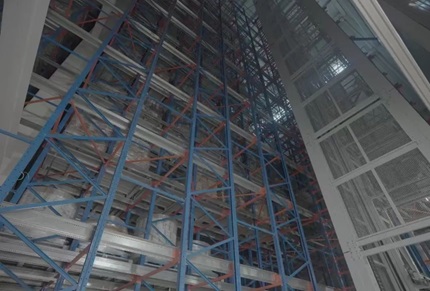
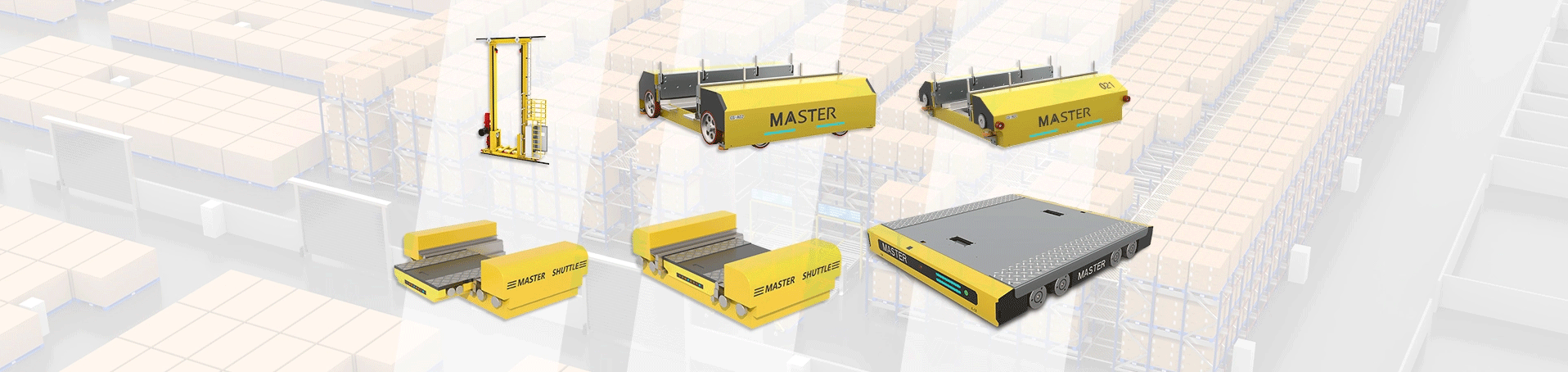
In the field of pallet-level automated storage, the four-way shuttle is one of the fastest-growing technology routes in recent years. Compared with traditional stacker crane systems (AS/RS) and pallet shuttle (parent-child) systems, the four-way shuttle demonstrates unique value in warehouse layout adaptability and system expansion flexibility. This article provides a professional analysis of the four-way shuttle system from three dimensions: technical architecture, selection logic, and core parameters.
I. Technical Essence: From "Fixed Dedicated Line" to "Flexible Public Transit"
Understanding the core value of the four-way shuttle requires clarifying its essential difference from two-way shuttles. These are not iterative alternatives but two technology routes adapted to different business scenarios.
Two-way shuttles can only travel back and forth along rails within a single aisle, with their operational scope strictly confined to that aisle, requiring cooperation with elevators at the aisle ends for vertical transfer. Their technical essence is exchanging fixed paths for ultimate operational efficiency and reliability. Under full-load continuous operation, the single-machine storage/retrieval cycle is 1.5 to 2 times that of a four-way shuttle.
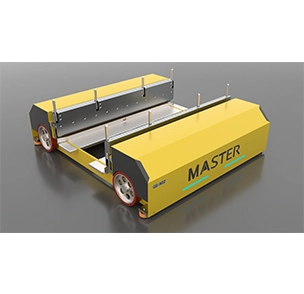
Four-way shuttles have the ability to travel in four directions—forward, backward, left, and right—and can achieve cross-aisle and cross-level scheduling through intersecting tracks. Their technical essence is exchanging path flexibility for equipment reuse rate and infrastructure cost-effectiveness-4. Multiple shuttles can be dynamically shared, balancing resources when some aisles are busy and others idle, avoiding equipment waste caused by uneven workloads.
Master's patent technology in this field (CN112978181A) further optimizes the reversing mechanism design of the four-way shuttle: using hydraulic reversing and lifting devices, reducing intermediate transmission links, resulting in lower failure rates, easier installation and maintenance, and significantly reduced operating noise-1. Its four-way shuttle adopts a mechanical cam lifting structural design, with a rated capacity of 1500kg, no-load speed of 1.5-2.0m/s, and positioning accuracy of ±2mm-2.
II. Selection Logic: When to Choose a Four-Way Shuttle?
The core of selection is not "chasing the new" but matching actual throughput, warehouse layout, and long-term planning. The following is a decision reference framework:
In terms of infrastructure costs, the four-way shuttle has significant scale advantages: the entire warehouse requires only a small number of elevators and docking stations, and the marginal infrastructure cost decreases as the number of aisles increases. For multi-aisle warehouses with the same number of storage positions, the infrastructure investment of the four-way solution is typically 20% to 40% lower than the two-way solution-6.
In terms of expansion flexibility, the four-way shuttle offers greater long-term value. The two-way solution is "rigid planning": adding new aisles in the later stage requires synchronously adding elevators and buffer lines, with large-scale renovation and production stoppage. The four-way solution is "flexible planning": after the track infrastructure is laid once, later expansion only requires adding shuttles, without modifying the racking and infrastructure-7.
III. Core Technology and System Composition
System Components
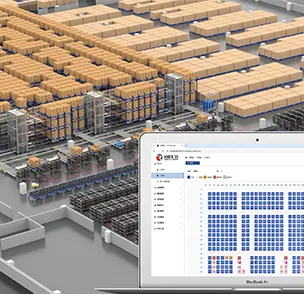
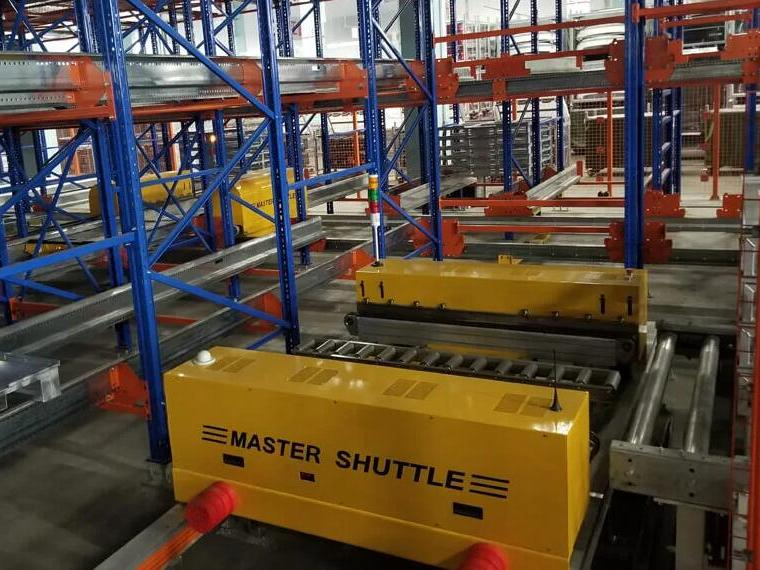
The four-way shuttle intelligent storage system consists of four-way shuttles, rapid vertical elevators, horizontal conveying systems, racking systems, and WMS/WCS control systems. Each unit is interconnected via wireless networks, completing FIFO or LIFO storage and retrieval operations under the unified scheduling of WMS/WCS.
Core Component Technical Parameters
Four-Way Shuttle Body: Master's product has a rated capacity of 1500kg, no-load speed of 1.5-2.0m/s, positioning accuracy of ±2mm, reversing time of approximately 3 seconds, uses lithium battery power, with 6-8 hours of runtime at room temperature and approximately 2 hours of charging time-5.
Racking and Rail System: The machining and installation accuracy requirements for four-way shuttle racking are higher than traditional racking, which is a key part of its cost structure. Racking space utilization can reach approximately 90%, 10%-60% higher than traditional storage modes.
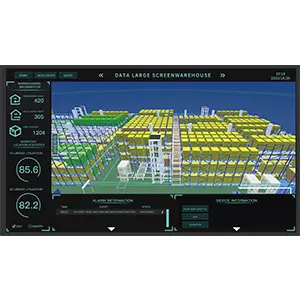
Software Control System: WMS is responsible for overall inventory management and order strategy optimization, while WCS is responsible for real-time equipment scheduling and status monitoring. Master has obtained the patent for "Digital Twin-based Four-Way Shuttle Logistics Modeling Method, System, and Medium," applying digital twin technology to achieve efficient modeling and optimization of logistics processes.
IV. Applicable Industries and Typical Scenarios
The four-way shuttle system is widely applicable to the storage of food, beverages, dairy products, pharmaceuticals, tobacco, fine chemicals, and is particularly suitable for low-temperature cold chain logistics. Its core scenarios include:
Cold Chain Logistics: Reducing manual entry into low-temperature areas for operations, with high-density storage reducing cold storage energy consumption. Master's four-way shuttle supports operation in -25°C low-temperature environments.
Irregular Warehouse Automation Retrofit: Whether L-shaped, U-shaped, or older warehouses with dense column grids, the four-way shuttle can flexibly adapt, making it a preferred solution for existing warehouse automation upgrades.
Manufacturing Line-side Warehouses and Finished Goods Buffering: Adapts to complex workshop layouts, supports multi-aisle dynamic scheduling, and improves overall equipment utilization.
E-commerce and Retail Distribution Centers: Flexible scheduling to handle order fluctuations, with multi-shuttle coordination improving throughput capacity.
V. System Integration and Global Delivery
Master has full-chain service capabilities from planning and design to equipment manufacturing and system integration, achieving full-system integrated delivery for multiple automation projects in overseas markets including Malaysia. As of 2025, the company has successfully implemented and delivered nearly 100 automated warehouse systems to the market, accumulating rich project experience in food cold chain, pharmaceuticals, chemicals, and other fields.
Whether facing the efficiency demands of high-bay warehouses or the flexibility needs of irregular warehouses, the four-way shuttle system demonstrates unique technical and economic value in specific scenarios. Understanding its technical essence and selection logic helps make more precise decisions in automation solution planning.


 English
  Español
  português
  العربية
  tiếng việt
  ไทย
ไทย  Indonesia